The Purpose of the Parables

December 4, 2025

Theological Summary

Key insights and takeaways from the text.

This foundational passage explains Jesus' deliberate use of parables to reveal the 'secrets of the kingdom of heaven' to His disciples while simultaneously obscuring these truths from those with unreceptive hearts. Jesus clarifies that spiritual understanding is a gift, given to those who are open and seeking, but withheld from those who willingly remain spiritually blind and deaf, thereby fulfilling the prophecy of Isaiah. This distinction underscores a divine principle: to those who 'have' (spiritual receptivity), more will be given; but from those who 'do not have' (a hardened heart), even what they seem to possess will be taken away. For Christians today, this scripture holds immense importance as it profoundly calls us to examine the condition of our own hearts. It is a powerful reminder that merely hearing the Gospel is insufficient; true discipleship demands a humble, receptive spirit that actively seeks to perceive and understand God's truth. This passage warns against spiritual complacency, urging us to guard against the hardening of our hearts and the closing of our spiritual eyes and ears, which can lead to a tragic lack of understanding and responsiveness to divine revelation. It highlights that the privilege of knowing God's mysteries comes with the responsibility of continually cultivating a heart that is open to His ongoing teaching. Furthermore, this text illuminates the blessedness of having 'eyes that see and ears that hear' the profound realities of God's kingdom, a privilege many prophets and righteous people longed for but did not experience. It challenges us not only to appreciate this divine gift of insight but also to actively live in light of it, allowing God's word to transform our lives and deepen our faith. The passage ultimately serves as both a comfort regarding the divine provision of understanding for His own and a sober warning to maintain spiritual vigilance and hunger for God's truth, ensuring that we remain among those who genuinely understand and respond to the call of the Kingdom.

Scripture

Matthew 13:10-17; Mark 4:10-12; Luke 8:9-10

Old Testament Connections

Isaiah 6:9-10 (NIV)

"He said, Go and tell this people: Be ever hearing, but never understanding; be ever seeing, but never perceiving. Make the heart of this people calloused; make their ears dull and close their eyes. Otherwise they might see with their eyes, hear with their ears, understand with their hearts, and turn and be healed."

Jesus' explanation for speaking in parables directly fulfills Isaiah 6:9-10, demonstrating that the spiritual blindness and deafness prophesied for Israel in Isaiah's time persists, preventing many from understanding the secrets of the kingdom. This illustrates God's sovereign judgment and also highlights the blessedness of the disciples who are given to understand, unlike those whose hearts remain calloused.

Psalm 78:2 (NIV)

"I will open my mouth with a parable; I will utter hidden things from of old—"

Psalm 78:2 prophetically announces the method of divine revelation through parables to "utter hidden things from of old," directly foreshadowing Jesus' use of parables to disclose the "secrets of the kingdom of heaven." This establishes a continuity in God's communicative strategy to both reveal and conceal spiritual truths, as explained in the New Testament passages.

A Moment of Prayer

A prayer inspired by today's topic.

Heavenly Father, we are grateful for the profound wisdom embedded in Your parables, which reveal deep truths about Your kingdom and our journey with You. Grant us discerning hearts and attentive ears to truly grasp the spiritual insights You intend for us to learn from these sacred stories. May they illuminate our understanding, guide our decisions, and transform us into more faithful reflections of Your love and grace. Amen.

Historical Context

The world behind the Word.

The scripture from Matthew 13:10-17, Mark 4:10-12, and Luke 8:9-10 details a crucial moment where Jesus explains to his disciples why he teaches in parables. This explanation is profoundly rooted in the historical, cultural, and religious milieu of first-century Palestine, reflecting the varied receptivity to Jesus' message and the distinct theological perspectives of the evangelists who recorded these events. The authorship and dating of these synoptic Gospels significantly shape their presentation of this common tradition. Mark, generally recognized as the earliest Gospel, was likely composed around 65-70 CE, possibly by John Mark, a close associate of Peter. His primary audience was Gentile Christians, likely in Rome, who were navigating periods of persecution. Matthew and Luke, both written approximately between 80-90 CE, drew upon Mark's Gospel and a hypothetical common source known as "Q" (from *Quelle*, German for "source"), alongside their own unique materials. Matthew, traditionally attributed to the apostle Matthew, aimed his Gospel at a Jewish-Christian audience, possibly in Antioch or Syria, seeking to demonstrate Jesus as the long-awaited Jewish Messiah who perfectly fulfilled Old Testament prophecies. Luke, a Gentile physician and companion of Paul, addressed his Gospel to Theophilus and a broader Gentile Christian audience, emphasizing the universal scope of Jesus' ministry and salvation. Geographically, Jesus' ministry primarily unfolded in Galilee, a northern region of ancient Israel characterized by its diverse population, fertile lands, and bustling trade routes. The parables themselves often incorporated vivid imagery from the agrarian and fishing lifestyles common to the Galilean populace. This region, like all of Judea, was under the dominion of Roman occupation, albeit with local governance by client kings like Herod Antipas. The political atmosphere was perpetually charged with anti-Roman sentiment, heavy taxation, and a fervent undercurrent of messianic anticipation, often infused with nationalistic and liberationist hopes. Socially, the population was highly stratified, with a small elite (often collaborators with Roman authorities or the Temple establishment) at the top, and a vast majority of peasants, artisans, and the marginalized struggling at the bottom. Jesus' teachings, particularly those concerning the "kingdom of God," were inherently politically resonant, though his vision of this kingdom often diverged sharply from prevailing expectations of a military or political liberator. The cultural and religious landscape was defined by Second Temple Judaism, a complex and diverse religious tradition. The Jerusalem Temple stood as the spiritual heart, but local synagogues served as vital centers for worship, study, and community life throughout Galilee. Various Jewish sects competed for influence: the Pharisees, renowned for their meticulous adherence to both written and oral law and their significant popularity among the common people; the Sadducees, the priestly aristocracy linked to the Temple, who rejected oral tradition and focused exclusively on the written Torah; and the Zealots, revolutionary groups advocating for armed resistance against Rome. Amidst these groups, the majority were the "people of the land" (*Am Ha'aretz*), who, though observant, were perhaps less learned in the intricate points of legal interpretation. A widespread expectation of the Messiah—a divinely appointed figure destined to restore Israel's fortunes—pervaded Jewish thought. In this context, Jesus' use of parables served multiple purposes: they were a common pedagogical method of the era, making profound spiritual truths accessible through relatable stories. However, as the scripture highlights, they also functioned both to reveal and to conceal, distinguishing those who were spiritually receptive from those whose hearts were hardened. The quotation of Isaiah 6:9-10 is profoundly significant here, drawing upon an ancient prophetic tradition that spoke of a divine judgment where some would hear and see, yet fail to understand, leading to their spiritual blindness. For the disciples, understanding the "secrets of the kingdom" was a blessed privilege, a spiritual insight denied to many others, echoing themes of divine election and judgment prominent in the broader prophetic tradition. The nuanced differences in the synoptic accounts, such as Mark's explicit "so that they might not turn and be forgiven" versus Matthew's more implied "Otherwise they might see...and turn, and I would heal them," underscore the evangelists' distinct theological interpretations of divine purpose and human accountability.

Sermons
2 Found

Matthew 13:10-17, The Reasons For The Parables

Matthew 13:10-17, The Reasons For The Parables

Calvary South Denver
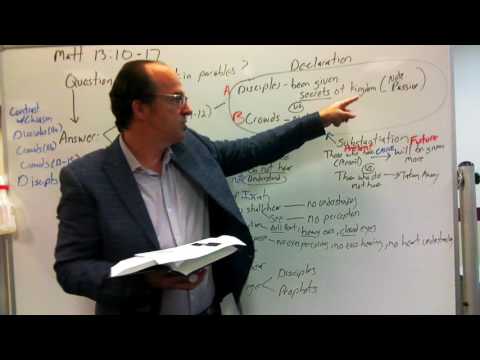
Interpretation of Matthew 13:10 17 The Meaning of Jesus' Use of Parables

Interpretation of Matthew 13:10 17 The Meaning of Jesus' Use of Parables

Deep Dive Spirituality with Dr. Brian Russell